




A Series as a Tribute to the Journalism Profession

A Series as a Tribute to the Journalism Profession
The story of how the series “Journalists – Witnesses Before the Hague Tribunal” was created and what happened behind the scenes
photo: Mediacenter Sarajevo
The sentence by Philip L. Graham, publisher of The Washington Post, that “journalism is the first rough draft of history,” seemed to the Mediacentar project team to be the perfect title for the project that gave rise to the documentary series “Journalists – Witnesses Before the Hague Tribunal.” That powerful message precisely described the idea and aspiration to document the role of journalists and the media in the war in the former Yugoslavia — but not the war-mongering role. Rather, the other side of the story — where journalism and journalists shone at their very best.
The curiosity about how media reports are used in proceedings before the International Criminal Tribunal for the former Yugoslavia (ICTY), and the idea of interviewing journalists who testified before that court, had to be transformed into a document that would attract a donor’s interest. The alchemical process of transforming something intangible, like an idea, into tangible content — a project document — has for years been successfully carried out at Mediacentar by Maida Muminović. A demanding plan was developed, which also included retrieving media materials from the ICTY’s publicly available archives that had been used as evidence, as well as obtaining audio and video recordings of journalists’ testimonies with the assistance of the International Residual Mechanism for Criminal Tribunals (UN IRMCT), the successor to the ICTY.
After the Embassy of the Netherlands in Bosnia and Herzegovina supported the project through the MATRA programme, the Mediacentar project team faced numerous challenges — from finding information about journalists who had testified before the ICTY, to organizing interview recordings, to developing a methodology for organizing the retrieved media materials from the ICTY archives, and finally deciding how to present the results of months of work to the public.
Which journalists testified before the ICTY?
After months of research, the Mediacentar investigative team (Selma Zulić-Šiljak and Dragan Golubović) established that at least 35 journalists had appeared before ICTY judges. Years later, information surfaced about two additional journalists who had not been identified during the initial research: Muharem Nezirović and Zvonko Marić. With these newly established facts, it can be concluded that at least 37 journalists appeared before ICTY judges (Aernout van Lynden, Anthony Birtley, Andrew Hoog, Alija Lizde, Baton Haxhiu, Branimir Grulović, Den Demon, Deborah Christie, Dejan Anastasijević, Edmond Vanderostyne, Edward Ed Vulliamy, Eve-Ann Prentile, Francz-Josef Hutsch, Florence Hartmann, Ian Traynor, Jacky Rowland, Jeremy Bowen, John Bowen, John Sweeney, Jovan Dulović, Karmen Brlić-Jovanović, Marita Vihervouri, Martin Bell, Milivoje Mihailović, Muharem Nezirović, Nenad Zafirović, Robert Block, Richard Lyntton, Sead Omeragić, Slavoljub Kačarević, Snježan Lalović, Sredoje Simić, Šefko Hodžić, Veton Surroi, Zoran Petrović-Piroćanac, Zvezdana Polovina and Zvonko Marić).
Part of the information about the journalists was gathered through cooperation with ICTY staff and later with UN IRMCT staff, primarily Nemanja Stjepanović, while the rest was collected through online research.
From the outset, it was clear that it would not be possible to interview all the journalists, for various reasons. Some had passed away, such as Jovan Dulović and Dejan Anastasijević. Snježan Lalović declined to be interviewed. Aernout van Lynden initially responded positively to the first email invitation but later changed his mind. He stopped responding to emails and ignored voicemail messages left on his private home phone. Karmen Brlić-Jovanović initially accepted the invitation through an intermediary but later also withdrew. Jeremy Bowen was eventually located in a Sarajevo hotel after a tip-off from a friend. He had returned to Sarajevo with a BBC crew but was in COVID-19 isolation. After three letters were left for him at reception — since he did not respond to emails — he agreed to the interview once his isolation period ended.
The strategy was to secure the most prominent foreign journalists as well as all journalists from the former Yugoslavia. Fourteen journalists responded positively (Andrew Hogg, Alija Lizde, Branimir Grulović, Edward Ed Vulliamy, Florence Hartmann, Jacky Rowland, Jeremy Bowen, John Sweeney, Martin Bell, Sead Omeragić, Slavoljub Kačarević, Anthony Tony Birtley, Veton Surroi and Zvezdana Polovina).
Time to Record the Interviews
The interviews were conceived not as traditional journalistic interviews, but as semi-structured conversations in which the interviewer could refine answers through follow-up questions. Anida Sokol, Head of Research at Mediacentar, and Elvira Jukić-Mujkić, then editor of Media.ba, prepared around 100 questions divided into three blocks (introduction and wartime reporting experience; testimony before the ICTY; and journalism in general).
Filming could begin. Recordings were organized in six European cities. The production team included journalists Boro Kontić, Tihomir Loza, Drago Hedl, Agron Bajrami and Ahmed Burić. The cameramen were Jasmin Hrnjica, Edin Busuladžić, Dejan Miholjević and Igor Miličić.
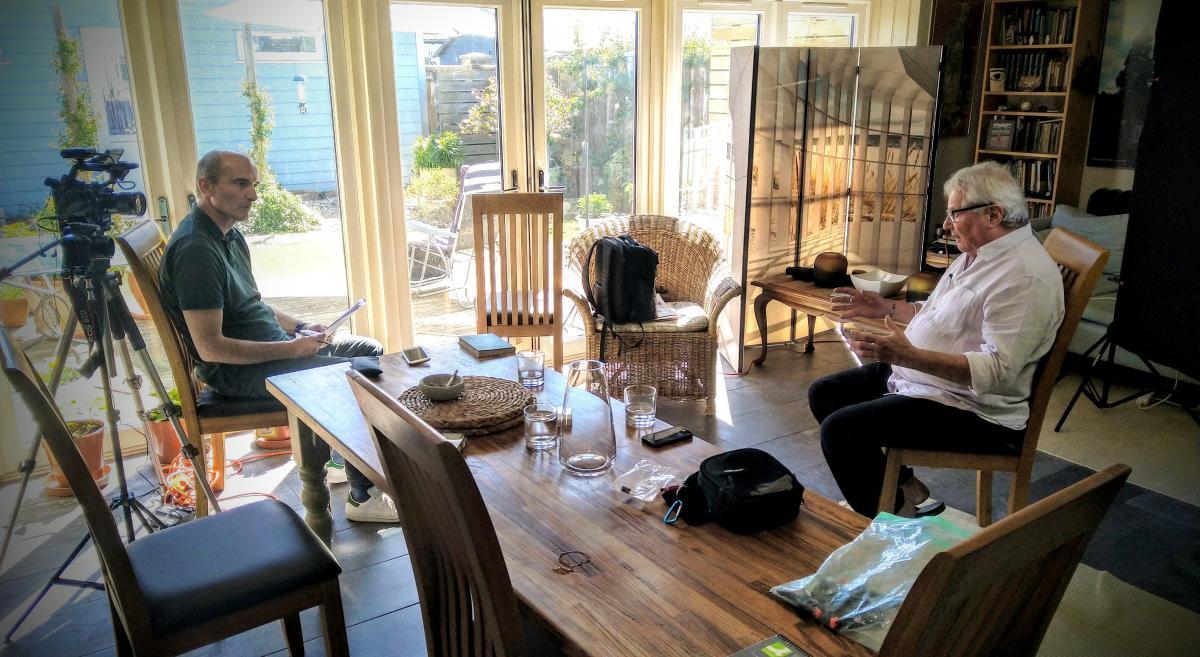
Tihomir Loza and Andrew Hogg
Through 14 recorded interviews, at least 20 hours of testimony were documented about everything — about war reporting, personal stories from the frontlines, conversations with people who are now serving prison sentences across Europe as convicted war criminals, and about events that only life itself could script.
Four minutes of Sead Omeragić’s story of his escape from Trebinje could serve as the script for a short film. The fact that Alija Lizde first learned he would testify before the Tribunal not through official channels but directly from Berislav Pušić — who was already behind bars in Scheveningen — suggests that work with potential and later actual witnesses was not always a strictly guarded secret.
Florence Hartmann’s testimony about how she and her colleague Helena Despić-Popović uncovered the existence of a mass grave at Ovčara near Vukovar, or Ed Vulliamy’s testimony about discovering detention camps near Prijedor together with Penny Marshall, demonstrate how journalism can change someone's life.
During the interview, Branimir Grulović recounted an event involving a young man from Tuzla whose name he did not wish to mention. Grulović lent him his official satellite phone so he could call his parents in Tuzla.
“He called home — a young man originally from Tuzla. He had attended the military academy; the war caught him off guard and he remained in the Army of Republika Srpska. His mother answered the phone. As I understood it at the time, his family had received information that he had been killed somewhere. When he spoke, his mother, of course, did not believe she was talking to her son. He tried to convince her by describing the arrangement of certain things in their household. At one point, she must have realized that he was truly alive and that she was indeed speaking to her child — and from the shock and emotion, she collapsed. The conversation then continued with his father.”
Series, Website, Book
The Mediacentar research team collected and analyzed 2,760 media pieces of evidence from the Hague Tribunal’s trial records database. With the support of staff from UN IRMCT, nearly 200 hours of testimony from 19 journalists were archived in Mediacentar’s collections.
As mentioned, through interviews with 14 journalists, the production team recorded at least 20 hours of material. This represents a substantial body of material that is yet to become the subject of academic and other research. Mediacentar was then faced with the challenge of how to present months of work to the public. We decided to create a specialized project website, Media as Evidence, and a publication titled The First Draft of History.
The six-episode series “Journalists – Witnesses Before the Hague Tribunal”, broadcast first in Bosnia and Herzegovina and later in Croatia and Montenegro, tells the untold story of journalists who voluntarily appeared before Tribunal judges, took an oath to tell the truth, and subjected themselves to days of cross-examination about reporting that in some cases had occurred more than 20 years earlier.
A Tribute to the Journalism Profession
There is no way to clearly present the role of journalists in the wars in the territory of the former Yugoslavia. There is no clear evidence, but there are indications that reporting by foreign journalists from Bosnia and Herzegovina was one of the motives for those who had the capacity to initiate the establishment of a court for the prosecution of war crimes. On the other hand, there is the recorded testimony of journalist Martin Bell about how his crew filmed a column of refugees from Zvornik at the very beginning of the war. In the interview, Bell recalled that a man carrying a baby wrapped in a “green blanket” passed through the frame, and then he said: “And 20 years later, I received an email from a young man in Canada who was that baby in the green blanket. His uncle took care of him. He lost his parents and wrote me a very moving letter, thanking me, because that was the only record he had of what had happened to his family.”
During the broadcast of the series on N1 television in Bosnia and Herzegovina, in response to my private Facebook post announcing that the series was being broadcast, I received a message from Satko Mujagić, a former detainee from Omarska, which read: „Vulliamy, with Penny Marshall, saved the lives of at least 172 detainees (the last group) by entering Omarska on August 5, 1992. If that were all he did, thank him.“
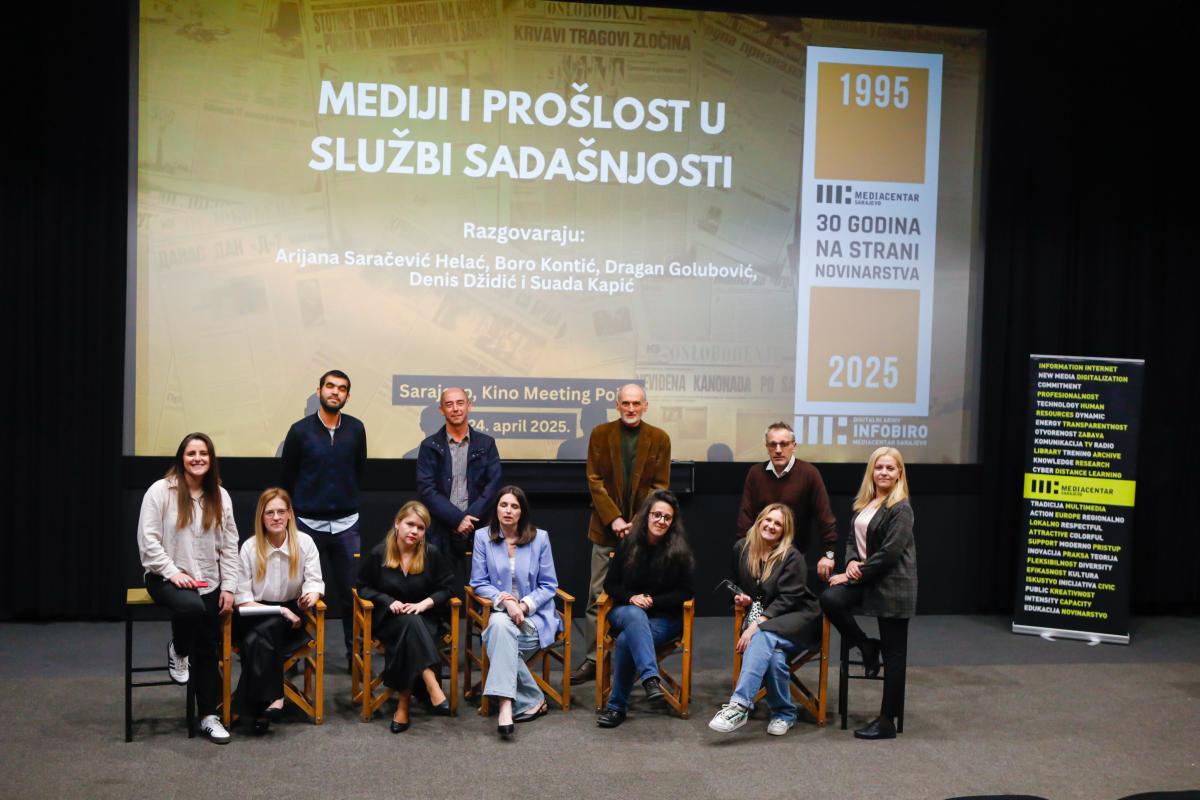
Everyone had their position and their task within the team: Tarik Moćević, Mustafa Mustafić, Boro Kontić, Dragan Golubović, Selma Fukelj, Nejra Hasečić, Selma Zulić-Šiljak, Anida Sokol, Maida Muminović, Maja Ćalović and Aida Nadarević.
The Mediacentar Sarajevo team, from the initial idea to the realization of the series, consisted of 11 people. In the group photograph, we are arranged like a football lineup — some standing, others seated — but behind that simple composition lies clearly divided responsibility and team coordination.
Everyone had their position and their task: from research and archival work, through production and filming, to editing and post-production.
To rescue from oblivion, first and foremost, the people — and then the journalists who testified in the name of justice — in sporting terms means scoring a goal in extra time: a goal dedicated to the journalism profession.